Interview Internal Communication 1
Corporate Communications
Employee Experience
Promover el comportamiento de los empleados mediante la comunicación interna - Entrevista con el profesor Shimizu, autor de "Gestión de la comunicación interna" (1ª parte)
Jan 3, 2019
En los últimos años, la comunicación interna (※1) ha atraído la atención desde las perspectivas de la globalización empresarial, las fusiones y adquisiciones y la reforma del estilo de trabajo. Es probable que muchas empresas se enfrenten al reto de cómo garantizar que sus empleados en el extranjero, regionales y nacionales entiendan y adopten su filosofía de gestión y sus objetivos. En esta entrevista en dos partes, preguntaremos al invitado Shigemichi Shimizu, profesor visitante de la Universidad Tsukuba Gakuin, que editó y escribió el libro "Gestión de la comunicación interna" en febrero de 2019, por qué la comunicación interna está atrayendo tanta atención ahora y por qué es tan importante.

En los últimos años, la comunicación interna ha atraído la atención desde las perspectivas de la globalización empresarial, las fusiones y adquisiciones y la reforma del estilo de trabajo. Es probable que muchas empresas se enfrenten al reto de cómo garantizar que su filosofía de gestión y sus objetivos se entienden y se difunden entre los empleados de las oficinas regionales y en el extranjero, así como entre los que trabajan desde casa. En esta entrevista en dos partes, hablaremos con el invitado Masamichi Shimizu, profesor visitante de la Universidad Tsukuba Gakuin, coautor del libro "Gestión de la comunicación interna" en febrero de 2019, sobre por qué la comunicación interna está atrayendo tanta atención en este momento y la importancia de la comunicación interna. El público objetivo eran unos 10.000 vendedores, pero cuando abrimos la puerta, descubrimos que no se leía el boletín de la empresa.
Brightcove (BC) OhnoBrightcove (BC) Ohno Thank you for taking the time to come to our office today. We have also been receiving an increasing number of inquiries about using video for the purpose of internal communication, and I read your book “Internal Communication Management” with great interest. Before we talk about the content, could you briefly tell us about your career and the motivation behind publishing this book? Professor Shimizu I had originally hoped to work for a newspaper company, but my wish was not granted, and in 1973 I joined Fukoku Mutual Life Insurance Company as a new graduate. At first I worked in the Personnel Department, but after a year and a half I was transferred to the Public Relations Department. There I was in charge of internal public relations. BC Ohno You’ve been in charge of internal public relations since 1974! I’m surprised. Professor Shimizu It was just by chance, but soon after joining the company I proposed to the head of the personnel department that we produce a recruitment guide book for students. I was put in charge of the project, and I think the fact that the guide book I put together with the editorial team of new employees was well received within the company led to my being selected for the internal communications department.Professor Shimizu I had originally hoped to work for a newspaper company, but my wish was not granted, and in 1973 I joined Fukoku Mutual Life Insurance Company as a new graduate. At first I worked in the Personnel Department, but after a year and a half I was transferred to the Public Relations Department. There I was in charge of internal public relations. BC Ohno You’ve been in charge of internal public relations since 1974! I’m surprised. Professor Shimizu It was just by chance, but soon after joining the company I proposed to the head of the personnel department that we produce a recruitment guide book for students. I was put in charge of the project, and I think the fact that the guide book I put together with the editorial team of new employees was well received within the company led to my being selected for the internal communications department.
Tras mi traslado, me encargaron la elaboración de un boletín interno, pero el público objetivo eran las 10.000 vendedoras de seguros de vida de la época. Sin embargo, cuando abrí la revista, me di cuenta de que no se leía mucho. Cuando fui a las oficinas de ventas, descubrí que las revistas se tiraban a la basura (risas). Sentí que era necesaria una reforma fundamental de la revista de empresa, así que leí una revista semanal para mujeres todas las semanas y revisé los artículos de la revista de empresa. Me centré en artículos que resumían la vida y el trabajo de las vendedoras de seguros de vida en un estilo de reportaje. Esto fue muy bien recibido, e incluso el presidente de la época se dio por enterado. Este fue el comienzo de mi dedicación a la comunicación interna. En 1977, me trasladé a la Japan Management Association, donde trabajé como redactora y reportera de una revista de negocios. En 1989 pasé a ser jefe de la Oficina de Relaciones Públicas, y luego director general, y me dediqué a las relaciones públicas durante un total de 13 años.
After that, I worked as an environmental management consultant and then taught courses on environmental management and public relations at a university. BC Ohno In 1993, you published a book called “Corporate Culture and Public Relations” with Nikkei Publishing, but could you tell us how that came about? Professor Shimizu When I was working at the Japan Management Association, I took part in writing a series of five books on public relations to commemorate the 15th anniversary of the establishment of the Japan Institute for Social and Economic Affairs. At the time, there were new trends in internal communications, and we interviewed 80 companies and published the book under the title “Corporate Culture and Public Relations”. BC Ohno Of course, the term “internal communication” didn’t exist at that time, did it? Professor Shimizu At the time, it was called “internal public relations”, but because the content was a little narrow, we used the term “corporate culture” to include management principles and visions, and wrote a book about successful cases of internal public relations. After that, we published a book on administrative reform in the US called “Administrative Reform”, which was highly acclaimed by everyone.BC Ohno In 1993, you published a book called “Corporate Culture and Public Relations” with Nikkei Publishing, but could you tell us how that came about? Professor Shimizu When I was working at the Japan Management Association, I took part in writing a series of five books on public relations to commemorate the 15th anniversary of the establishment of the Japan Institute for Social and Economic Affairs. At the time, there were new trends in internal communications, and we interviewed 80 companies and published the book under the title “Corporate Culture and Public Relations”. BC Ohno Of course, the term “internal communication” didn’t exist at that time, did it? Professor Shimizu At the time, it was called “internal public relations”, but because the content was a little narrow, we used the term “corporate culture” to include management principles and visions, and wrote a book about successful cases of internal public relations. After that, we published a book on administrative reform in the US called “Administrative Reform”, which was highly acclaimed by everyone.
In 2002, we also published a book called “Corporate Communication Strategy”, and since then we have continued to publish a book every year, including co-authored works. The idea of implementing external communication based on internal communication. BC Ohno** Actually, within our company, we use the term “corporate communication” rather than “internal communication”. This is because it is now necessary to share awareness and goals not only with employees, but also with partners, franchisees and suppliers. Professor Shimizu That’s right. In “Corporate Communication Strategy”, we positioned all communication carried out by a company as corporate communication. In “Internal Communication Management”, we focused on inside-out-style public relations. This is a way of thinking that aims to improve external reputation based on the results of initiatives within the company. In the book, we feature Itochu Corporation as one example of a successful case.Professor Shimizu That’s right. In “Corporate Communication Strategy”, we positioned all communication carried out by a company as corporate communication. In “Internal Communication Management”, we focused on inside-out-style public relations. This is a way of thinking that aims to improve external reputation based on the results of initiatives within the company. In the book, we feature Itochu Corporation as one example of a successful case.
Okafuji encabezó una reforma de las prácticas laborales a partir de 2013 con el objetivo de elevar el estatus del negocio de la empresa comercial, que suele ser difícil de entender. En concreto, la empresa emitió anuncios de televisión en los que se mostraban vídeos reales de cómo habían cambiado la vida y el trabajo de los empleados gracias a la introducción de medidas como el sistema de trabajo matutino, la gestión de la salud y los días sin traje.
Además, la empresa comunica el trabajo de la sociedad mercantil a sus empleados a través de la sección "Alta Dirección" de su intranet. En Japón, los "movimientos del Primer Ministro" también se hacen públicos en los periódicos y en la "página web oficial del Primer Ministro", ¿verdad? También en esta empresa, el presidente Okafuji hace públicos todos sus movimientos, incluyendo con quién se ha reunido y qué ha dicho. Con estas medidas, la empresa está expresando la imagen del trabajo, a menudo difícil de entender, de una empresa comercial a través de las acciones y las vidas de sus empleados. Además, al ser vídeo, también expresa el movimiento de las emociones. Yo llamo a esto gestión "de dentro afuera".
The reason for publishing “Internal Communication Management” BC Ohno I see, so you are using the initiatives you have taken within the company externally as well. This is a good example of how corporate communication leads to corporate branding. I think there are some similarities with the Toyota Times, which is currently making headlines. So, could you tell us why you decided to publish “Internal Communication Management” again? Professor Shimizu I had always been interested in internal communication, but the direct trigger was when I heard a manager say at a reception at a general meeting in 2013, when I was appointed as the chair of the Japan Public Relations Society, that they were putting a lot of effort into internal communication.BC Ohno I see, so you are using the initiatives you have taken within the company externally as well. This is a good example of how corporate communication leads to corporate branding. I think there are some similarities with the Toyota Times, which is currently making headlines. So, could you tell us why you decided to publish “Internal Communication Management” again? Professor Shimizu I had always been interested in internal communication, but the direct trigger was when I heard a manager say at a reception at a general meeting in 2013, when I was appointed as the chair of the Japan Public Relations Society, that they were putting a lot of effort into internal communication.
En aquella época, las empresas japonesas estaban llevando a cabo activamente fusiones y adquisiciones y reestructuraciones empresariales con empresas extranjeras y nacionales. Sin embargo, incluso varios años después de la fusión, oí que los sistemas internos no se habían unificado y que había muchos problemas para conseguir que las dos empresas se pusieran de acuerdo en las reuniones y demás. Pensé que podría haber problemas no sólo con la integración y revisión de los sistemas de información y los sistemas de personal, sino también con las medidas internas de relaciones públicas, así que organicé un grupo de estudio y realicé entrevistas a 23 empresas miembros de la Sociedad Japonesa de Relaciones Públicas sobre la situación y los problemas actuales. Los resultados fueron variados, y cada empresa respondió de forma diferente a preguntas sobre cuestiones como los problemas lingüísticos y de seguridad asociados a la globalización, el uso de sitios web internos de la empresa y de servicios de redes sociales, etc.
The issues faced by each company were diverse, and the discussions within the research group also went in many different directions, but in the end we decided to narrow down the theme to “management philosophy” and carry out research activities. When it comes to internal company PR, the PR department is usually in charge, but in order to get the management philosophy across to employees and encourage them to take action, the PR department alone cannot do it. It is necessary to conduct interviews with the management planning department, the human resources department, and the management team. So, with the cooperation of seven major companies, we conducted interviews to find out how corporate philosophy is communicated and shared with employees. ****The president himself devotes more time than other executives to interacting with employees BC Ohno As a result of the interviews, were there any patterns of success in companies where corporate philosophy is well-established? Professor Shimizu Yes. Companies where the top management actively engages in dialogue with employees tended to have a strong sense of corporate philosophy among their employees.BC Ohno As a result of the interviews, were there any patterns of success in companies where corporate philosophy is well-established? Professor Shimizu Yes. Companies where the top management actively engages in dialogue with employees tended to have a strong sense of corporate philosophy among their employees.
Los propios altos directivos están dispuestos a dedicar más tiempo que otros ejecutivos a crear oportunidades para hablar con los empleados. Además, hemos comprobado que, para hacer "personal" la filosofía de gestión, es muy eficaz ofrecer oportunidades a los empleados para que actúen de forma independiente, crear ocasiones para hacer presentaciones y recompensar las iniciativas excelentes. No basta con compartir la filosofía de gestión, es necesario que todos los empleados actúen de acuerdo con la misma filosofía.
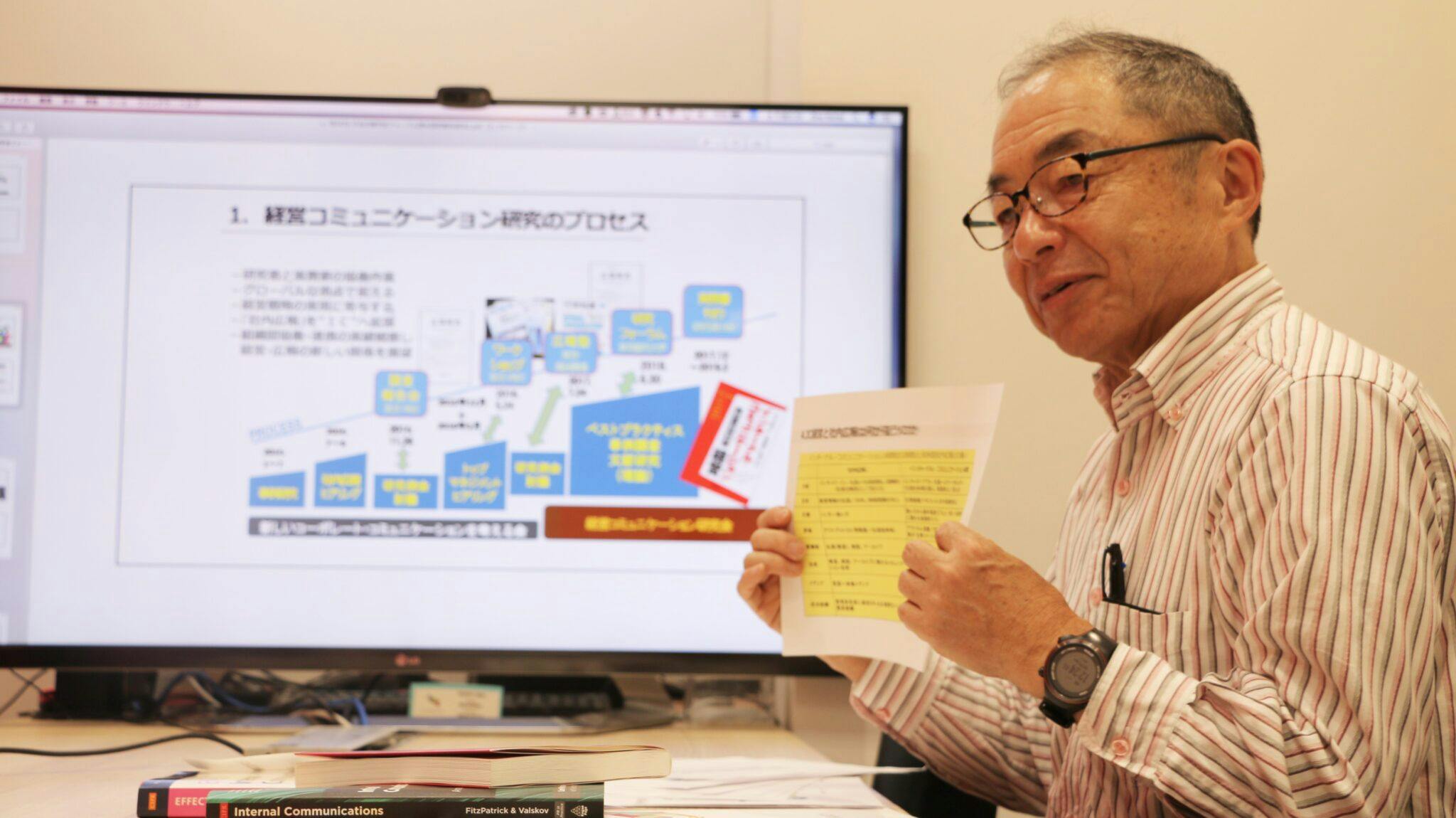
BC OhnoBC Ohno I see. It’s no use just sharing the corporate philosophy with employees if they don’t put it into practice. Is this the difference between internal PR and internal communication? Professor Shimizu That’s right. It is important to create a new corporate culture. To do this, it is necessary to get the cooperation of not only the public relations department, but also the human resources and training departments. It is also important for the management planning and CSR departments to encourage employees to act in line with the strategy.Professor Shimizu That’s right. It is important to create a new corporate culture. To do this, it is necessary to get the cooperation of not only the public relations department, but also the human resources and training departments. It is also important for the management planning and CSR departments to encourage employees to act in line with the strategy.
La alta dirección de la empresa debe comprender la importancia de garantizar que la filosofía corporativa sea comprendida por los empleados, y los departamentos pertinentes, como el de relaciones públicas y el de recursos humanos y formación, deben trabajar juntos para apoyar las acciones de los empleados, con el apoyo de los jefes de cada departamento. Con esto concluye la primera parte de la entrevista. El profesor Shimizu, que se dedica a la comunicación interna desde 1974 y ha investigado y analizado el proceso de evolución de la comunicación interna, tenía mucho que decir. En la próxima entrega, hablará del núcleo de la comunicación interna: entender la filosofía de gestión, hacerla propia y ponerla en práctica. *1 Dado que "comunicación interna" es un término japonés-inglés, en este post hemos utilizado "comunicación interna".